
Latest Articles
Consumer Electronics Manufacturing Quality Control
How Consumer Electronics Manufacturing Quality Control Prevents Mass Production Defects
For sourcing managers, importers, and brand owners, there is one constant nightmare in global procurement: The Golden Sample Trap.
You order an initial product sample for a white noise machine, emergency radio, or smart gadget. It arrives quickly, looks sleek, and performs flawlessly. You approve the sample and release a 30% deposit for a 5,000-unit mass production run. But when the container lands at your distribution center, 3% to 8% of the units fail straight out of the box due to battery drain, loose casings, or audio distortion.
The issue wasn’t your design—it was a breakdown in production oversight.
Implementing a standardized electronics manufacturing quality control framework is the single most effective way to protect your profit margins, customer reviews, and brand reputation before bulk shipping begins.
The 4 Most Common Mass Production Risks in Electronics
When sourcing custom gadgets or OEM audio products, quality drops usually stem from four common factory operational failures:
-
Sub-Component Substitution: To cut costs after quoting a tight margin, unvetted suppliers may swap out premium capacitors, smaller lithium batteries, or unbranded Bluetooth chips without notice.
-
Uncalibrated Assembly Lines: Manual solder joints, inconsistent screw torque, or poor shell sealing on waterproof gear often slip through without stage-by-stage testing.
-
Outdated Compliance Certificates: Customs holds and marketplace suspensions (e.g., Amazon, Walmart) happen when a factory’s CE, FCC, or RoHS test reports don’t match the exact sub-components used in your specific batch.
-
Transit Packaging Failures: Incorrect power adapter plug types, missing user manuals, or weak master cartons that collapse under sea freight humidity.
The 4-Stage Electronics Quality Control Framework
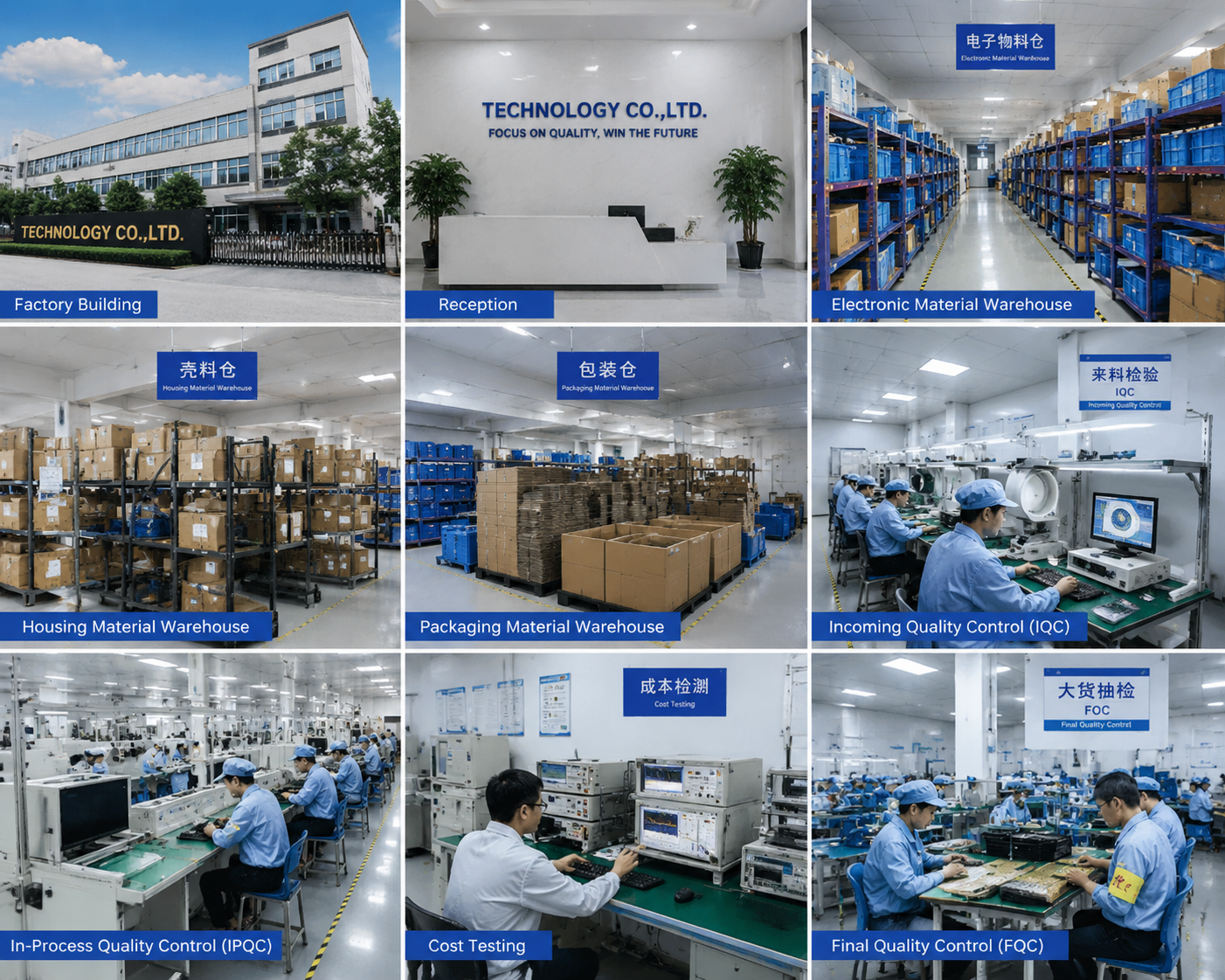
A reliable OEM/ODM electronics factory operates under a 4-stage Quality Assurance (QA) workflow. If your supplier cannot demonstrate these four steps, your bulk shipment is at risk.
[IQC] Incoming Quality Control ──► [IPQC] In-Process Quality Control
                                            │
[OQC] Outgoing Quality Control ◄── [FQC] Final Quality Control
Stage 1: Incoming Quality Control (IQC)
Quality management starts before assembly lines turn on. Every raw material and component is inspected upon delivery:
-
Batteries: Capacity testing, internal resistance checks, and safety circuit verification (MSDS / UN38.3).
-
Housing & Plastics: PANTONE color matching, surface finish, and scratch resistance checks.
-
PCBA Modules: Functional verification of motherboards, sound chips, and wireless modules.
Stage 2: In-Process Quality Control (IPQC)
Inspectors monitor active assembly lines in real time rather than waiting until all units are boxed:
-
First Article Inspection (FAI): The first 50 units off the line are fully disassembled and tested to ensure SMT machine calibration is exact.
-
Line Audits: Spot checks during manual soldering, shell pressing, and logo printing.
Stage 3: Final Quality Control (FQC) & Burn-In Testing
Once products leave the assembly line, 100% of the batch undergoes stress and functional testing:
-
24-Hour Aging/Burn-in Test: Sound machines and weather radios run continuously for 12 to 24 hours to detect early component failure or circuit overheating.
-
Drop & Drop-Box Testing: Fully packaged units are dropped from specified heights to simulate international shipping impacts.
Stage 4: Outgoing Quality Control (OQC) & AQL Sampling
Before container loading, QA auditors pull random samples based on internationally recognized AQL (Acceptable Quality Limit) Standards (typically AQL 2.5 for Major Defects and AQL 4.0 for Minor Defects):
-
Critical Defects (0% Allowed): Fire hazards, exposed wires, or dead batteries.
-
Major Defects (Max 2.5%): Unresponsive buttons, display glitches, or poor audio profiles.
-
Minor Defects (Max 4.0%): Minor packaging scuffs or slight printing misalignment.
How techlifehomes Guarantees Quality for OEM Buyers
At techlifehomes, we build strict quality controls directly into our manufacturing partnership workflow:
-
Transparent Testing Documentation: We provide full IQC and FQC inspection sheets, complete with batch numbers and video verification before final balance payment.
-
Verified Global Certifications: All sound machines, emergency radios, and smart gadgets carry updated CE, FCC, RoHS, and MSDS documentation ready for customs clearance.
-
Locked Material Specifications: Component specifications approved in your initial sample are locked into our supply contracts. No sub-component substitutions, ever.
-
100% Pre-Shipment Functional Testing: Every unit undergoes burn-in aging and acoustic/functional testing before sealing master cartons.
Safeguard Your Next OEM Electronics Shipment
Don’t let production defects ruin your brand reputation or burn your margins. Whether you need private-label white noise machines, emergency weather radios, or custom smart home gadgets, our engineering team delivers consistent quality at scale.
👉 [Contact techlifehomes Sourcing Team Today] to request an OEM quote, factory inspection checklist, or sample testing kit.
